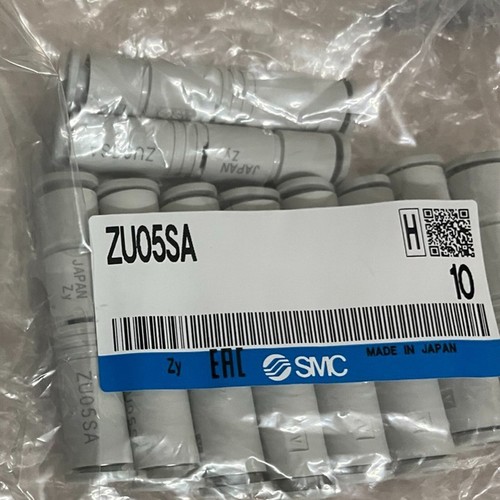
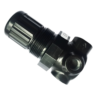
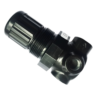
SMC ZU05SA Floating Joint
$96.80
- Pricing: All prices are listed in U.S. dollars (USD).
- Secure Payments: We process payments securely through PayPal and Stripe.
- Free Shipping: Enjoy complimentary standard shipping within the United States (estimated delivery: 5–7 business days).
- International Shipping: For orders outside the U.S., please review our shipping policies for details.
The SMC ZU05SA Floating Joint ensures smooth alignment and reduces stress in automated systems. Key specs: M5 connection, steel construction, and axial/angular misalignment compensation. Ideal for robotic arms and precision assembly applications, enhancing operational efficiency.
The SMC ZU05SA Floating Joint is designed to correct misalignment between actuators and driven objects, preventing damage and ensuring smooth operation in automated systems. This model, the ZU05SA, features a compact design and robust construction, making it suitable for a variety of applications.
Specifications:
- Model: ZU05SA
- Connection Thread: M5
- Material: Steel
- Allowable Axial Misalignment: ±0.5 mm
- Allowable Angular Misalignment: ±5 degrees
- Operating Temperature: -10 to 60°C
- Weight: Approximately 10g
Key Features:
- Misalignment Compensation: Corrects both axial and angular misalignment, reducing stress on connected components.
- Compact Design: Small form factor allows for easy integration into tight spaces.
- Durable Construction: Steel construction ensures long-lasting performance in demanding environments.
- Easy Installation: Simple thread connection for quick and easy installation.
- Improved System Performance: Reduces wear and tear on equipment, leading to improved overall system performance and reliability.
Model Suitability:
The ZU05SA Floating Joint is ideally suited for use in:
- Robotic arms
- Automated assembly lines
- Pick-and-place machines
- Precision positioning systems
- Applications where misalignment is likely to occur
By incorporating the SMC ZU05SA Floating Joint, users can significantly enhance the efficiency and longevity of their automated systems, minimizing downtime and maintenance costs.
 Shipping Options & Timeframes:
US / CA / AU / UK — Standard: FREE (Estimated 5–7 business days)
US / CA / AU / UK — Express: $15 (Estimated 3–4 business days)
Other countries: Flat-rate standard shipping and lead times vary by destination (see Shipping Policy for the full list).
Tracking: Provided after dispatch; delivery includes an order processing/dispatch window on business days.
Taxes & duties: Displayed/itemized at checkout; shipments are handled on a DDP basis per policy.